
If you wear glasses or contacts, there is a good chance you have astigmatism and have never heard it named. It is one of the most common reasons for blurry vision, and for many people it is quietly corrected by their prescription every single day.
I have done thousands of cataract and refractive procedures, and astigmatism comes up in almost every consultation I have. Understanding it makes it much easier to choose the right procedure, and the right lens, for your eyes.
What is astigmatism?
Astigmatism means your eye focuses light unevenly, so part of what you see is sharp and part is blurred or stretched. Picture a basketball: it has the same curve in every direction. Now picture a football lying on its side, steeper in one direction and flatter in the other. An eye shaped like the football focuses light at more than one point instead of one.
People with astigmatism may notice:
Blurry or smeared vision at distance and up close
Ghosting or shadows around letters
Glare, halos, or starbursts around lights at night
Eye strain, squinting, or headaches, especially with reading and screens
Because the blur is often mild, the brain adapts, and many people never realize anything is off. If your glasses prescription includes a "cylinder" and an "axis," that is your astigmatism, already being corrected.
Where astigmatism comes from
Astigmatism can come from three places in the eye, and often from more than one at once.
The cornea. The clear front surface of the eye does most of the focusing and is the most common source. If it curves more steeply in one direction, that is corneal astigmatism.
The lens. The natural lens inside the eye can also be unevenly curved or slightly tilted. This is lenticular astigmatism, and it can change as a cataract develops.
The tear film. A smooth layer of tears is the eye's first focusing surface. When it is uneven or unstable, as in dry eye, it adds blur that behaves a lot like astigmatism and can come and go.
Your total astigmatism is the combined effect of all three. That matters for surgery: in cataract surgery the natural lens is removed, so its contribution goes away while the cornea's stays. A good plan has to know how much comes from where.
Regular vs. irregular astigmatism
Many people believe astigmatism cannot be corrected. In most cases it can. The exception is irregular astigmatism from one of the causes listed below.
Regular astigmatism is the common, predictable kind. The steepest and flattest curves sit exactly 90 degrees apart, like a smooth, symmetrical football. Because it is so orderly, it can be fully corrected with glasses, toric contact lenses, laser vision correction, or a toric lens implant.
Irregular astigmatism means the surface is uneven or lopsided, so the curves do not line up neatly. Causes include keratoconus and other corneal thinning conditions, scars, injuries, prior eye surgery, and surface problems such as pterygium or corneal dystrophies. Glasses often cannot fully correct it, specialty lenses (rigid gas permeable or scleral) may be needed, and surgical results are less predictable.
Telling the two apart is one of the first things I do before recommending any procedure, because it changes which options are safe and sensible for you.
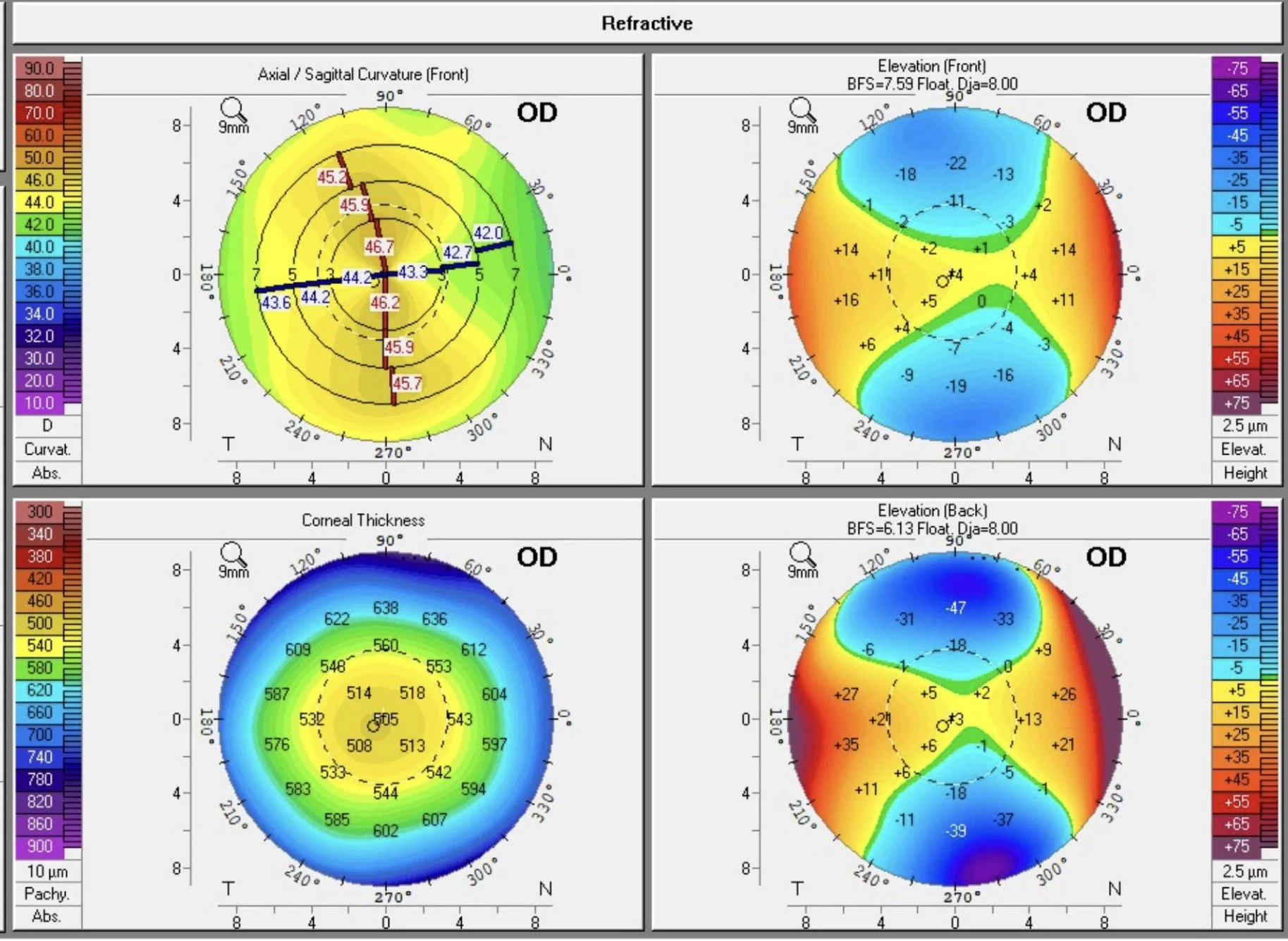
Dry eye makes astigmatism variable
If you have dry eye, your astigmatism can look different from one measurement to the next. The tear film is part of the eye's optics, so when it is patchy or unstable, both our testing devices and your own vision can shift, sometimes from blink to blink. Vision that is clear right after a blink and then fades or worsens as you work, read or drive is a classic clue.
This matters because we plan surgery from these measurements. Numbers taken on a dry, unstable surface can send a surgical plan off course. That is why I treat dry eye first when needed, with lubricating drops, prescription therapies, lid care, or in-office treatments, and repeat the testing until the readings are consistent.
How we measure it before surgery
Astigmatism is measured in clinic before any surgery, and I would never plan a procedure without it. We combine several tests:
Refraction: the familiar "which is better, one or two?" exam, which shows the prescription your eye needs.
Corneal topography and tomography: detailed maps of the front and back surfaces of the cornea that show the steep axis and whether the astigmatism is regular or irregular.
Optical biometry: precise measurements of eye length and corneal curvature used to choose lens power.
Tear film and surface evaluation: a check on whether dry eye is skewing the numbers.
When these tests agree with each other, I can plan with confidence. When they do not, that is a signal to dig deeper before moving forward.
To get the most accurate measurements, before your evaluation:
Use artificial tears regularly. A healthy, smooth tear film gives us more reliable readings.
Bring your current glasses or contact lens prescription with you. It gives us a useful starting point for comparing what we measure.
Correcting astigmatism with refractive surgery
Each procedure treats astigmatism differently, but the goal is the same: make the eye focus equally in every direction.
LASIK and PRK. An excimer laser reshapes the cornea, removing slightly more tissue along the steep axis so the surface becomes more evenly round. LASIK creates a thin flap first; PRK treats the surface directly with no flap. Both correct astigmatism along with nearsightedness or farsightedness.
ICL (implantable collamer lens). A thin lens is placed inside the eye, behind the iris and in front of your natural lens. A toric ICL has astigmatism correction built in and is aligned to your eye's steep axis. It leaves the cornea untouched, which can make it a good choice for higher prescriptions or thinner corneas and allows for more future lens implant options during RLE or cataract surgery.
RLE (refractive lens exchange). Your natural lens is replaced with an artificial lens, just as in cataract surgery, and a toric lens corrects the astigmatism at the same time. RLE is often considered for people in their 40s and older whose reading vision is fading or who have early cataracts.
Correcting astigmatism during cataract surgery
Cataract surgery replaces your cloudy natural lens with an artificial lens, and it is also the best moment to correct astigmatism. There are two main tools:
Toric IOLs. A toric lens has different powers in different directions to cancel out your astigmatism. During surgery I align it precisely with your eye's steep axis, and it is designed to stay in that position. Toric designs are available in monofocal, extended-depth-of-focus, and multifocal lenses.
Corneal laser relaxing incisions (LRIs). For smaller amounts of astigmatism, limbal relaxing incisions or femtosecond laser arcuate incisions gently relax the steep axis of the cornea.
Why it matters: even about one diopter of uncorrected astigmatism can keep distance vision in the blurry 20/40 range, so you would still need glasses even if the lens power is perfect. For patients choosing multifocal or extended-depth-of-focus lenses, leftover astigmatism can also undermine the very benefits those lenses are designed to deliver.
My recommendation
I highly recommend that patients take advantage of astigmatism correction during surgery. Cataract surgery and lens exchange are one-time opportunities to build the correction into the eye itself, rather than depending on glasses or contacts afterward. It gives you the best chance at sharp, comfortable vision with less dependence on glasses.
Astigmatism-correcting lenses and procedures often carry an added cost beyond standard surgery, and not every eye is a candidate. That is exactly why the careful measurements above come first.
Not sure whether you have astigmatism, or how much? A consultation will tell you, and we can talk through which option fits your eyes and your goals. Schedule your visit today.
This post is for general education and is not a substitute for an individual eye exam.
